
Calder/Tuttle: Tentative
David Kordansky Gallery and Pace, Los Angeles, January 21 – February 25, 2023
It escapes memory whether it really was Serge Daney who said that “the icon is the degraded form of the image.” Hammered by time into the shape of a cliche, an icon is only leftover as a symbol for what once was a unique image, an authentic experience, or a genuine savior. Referenced into oblivion, the image is unrecoverable from the instantly recognizable form that has become iconic. The iconic, in other words, is the known, the graspable, the image that attains pure representation and can develop no further, what you see is what you see. What you don’t see, however, was the subtle subject of two simultaneous shows at David Kordansky and Pace galleries of the artists Richard Tuttle and Alexander Calder. To be precise, Richard Tuttle’s solo show at David Kordansky coincided with “an exhibition of work by Alexander Calder, selected and installed by artist Richard Tuttle”1 at Pace, Los Angeles, each simultaneously titled “Tentative.” Both of these exhibitions, by turns oblique and straightforward and successful and hopeful and miserably failed, present limit cases in our moment of the ways in which artists with 20th century tools can approach the complexity of our definitively 21st century relationship to imagery, reality, and the defeat of both by language.
That toolkit starts with a historically specific means of approaching the sight of anything, that is with skepticism and disbelief. For Modernism, what actually exists does not actually exist until it has been envisioned, conceptualized, and framed by a method of picturing it as the real, reality as such. In Richard Tuttle’s exhibition this arrives by way of sculptures that appear flattened into pictures by eyes with photographic minds; a series of wall based sculptures entitled “Black Light,” that are as sculptural reliefs for the screen age. Constructed from paper, tape, glue, pencil, and watercolor, and consisting of compositions that protrude not more than few inches from the wall, Tuttle’s work scans easily and quickly glancing around the room or appearing in installation images, but like all reliefs is best viewed from the front.
Up close, each work’s manufacture is crude without appearing inexpert. Seemingly fabricated as studies for something larger, the surfaces contain remnants of process, pencil markings for cuts and folds, notes, rough edges, squiggles, and poorly met hinges that all testify to the handmade qualities inherent in these works. Intriguingly, the particular intricacies of each work’s manufacture seem ultimately unimportant. That scotch tape remains visible or that a note reading “Top” appears upside down at the bottom of the work is not what gives the work meaning. Meaning does appear however, distantly as on a horizon, when we consider that none of these particularities, quirks of paper joinery, off-kilter brushwork, Tuttle’s own handwriting, are visible at the appropriate viewing distance for works of this size, i.e. the one most often held by the camera.
Similarly, Tuttle’s framings and stagings of Alexander Calder’s work suffuse the gallery with the atmosphere of a photo shoot. Expertly choreographed throughout the space, each sculpture appears at precisely the moment and in precisely the angle at which one would stop to take a picture. The pedestals and supports surround and present views of each sculpture as much as the sculptures themselves and in doing so present the exhibition as a picture of itself as well. This is of course not to say that Tuttle, let alone Calder, had photography as a technical medium in mind as they worked. It is rather to notice something like Serge Daney noticed in his attempt to distinguish the “visual” from the “image:”
“The visual is both reading and seeing: it is seeing what is given to be read. …Perhaps we are going towards societies who know better and better how to read (which is to say: decipher, decode, acquire the reflexes of reading) and less and less to see. I call ‘image,’ then, what still relies upon an experience of vision, and ‘visual’ the optical verification of a procedure of power, whatever this may be (technological, political, advertising, military), a procedure which only requires, as sole commentary, a ‘receiving loud and clear.’”2
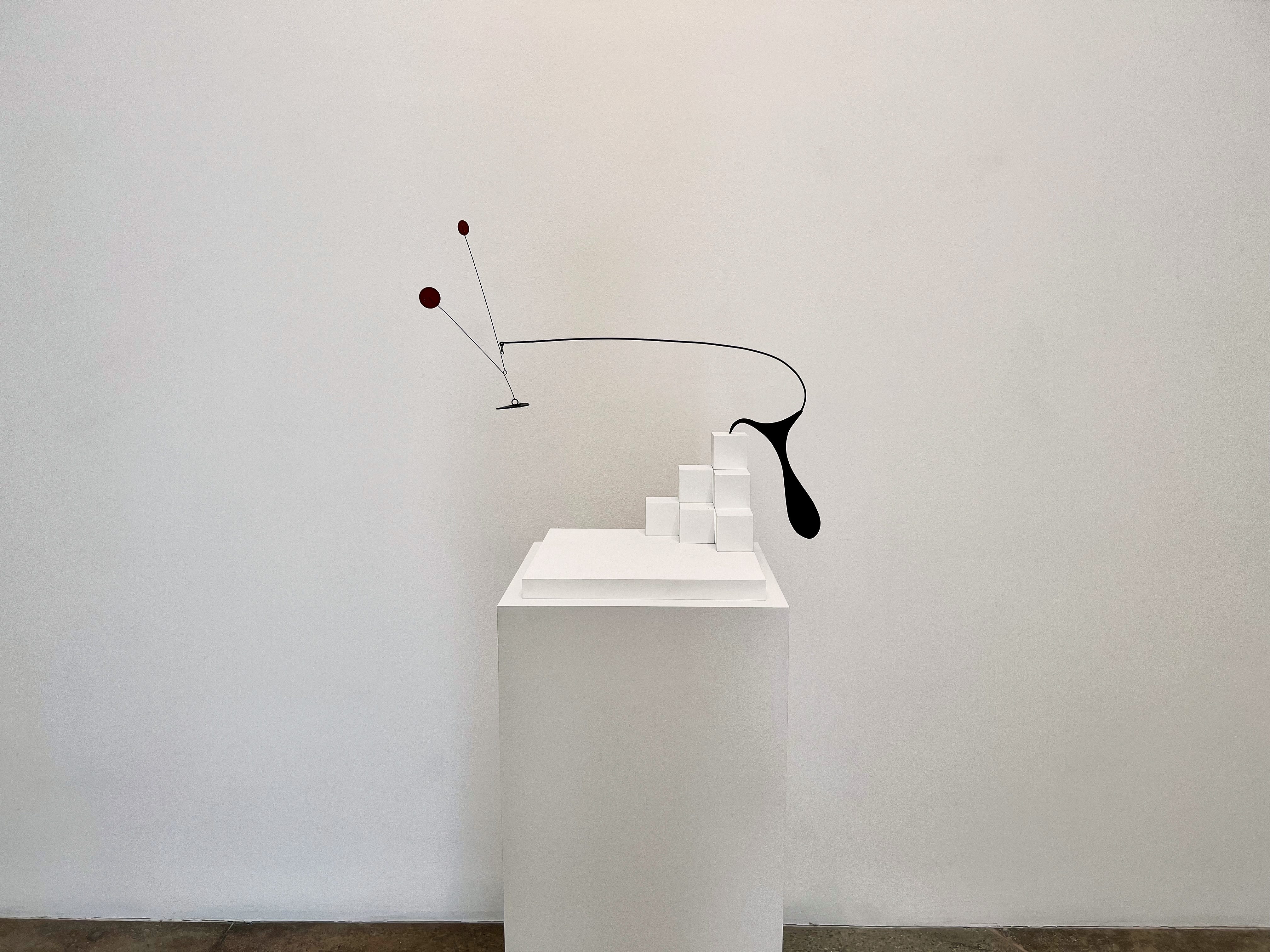
And isn’t receiving loud and clear precisely what Modernist techniques, the kind so deftly employed by Calder and Tuttle, are meant to accomplish? In cutting through the noise of an overfull world, aren’t such artworks attempting a further simplification and circumscription of what one mind can send to another through the retina? Photography, the camera, or the “visual,” are then technical expressions of a mode of thinking that really does resemble reading in the manner by which a reader or viewer retrieves meaning from the text or view at hand.
On the other hand, there is still the idea of a “picture” as an attempt to transmit a sense of specific contingencies; the light at a time of day, shadows in a breeze, the form of a figure far away across a wide plain, versus the picture as an attempt to provide its own parameters and the means of picturing operating only on themselves, imagery of images rather than imagery of the world. In his work, Tuttle often provides that logic’s limit, an attempt to make a branch of Modernism’s reflexive flowering back into the tree itself, so that our meaning making capacities might be seen as the world’s contingency, content finding its form in the chance operations of the hand made and the organic, no matter how directed toward legibility and intention. As Tuttle himself has stated:
“There is a discrete charm in something that is made that allows it to circulate, even though what cannot may have greater charm, like the light in an otherwise blue sky, the twinkle in an eye. How do those circulate? Only by making what cannot be made, what is beyond its own fixity, what is not under control, like thought, place, or action. Something must be made for it to circulate, to happen, even as it passes the maker’s limits, where the viewer intends the circulation to end, like making something that doesn’t go together… It is the possibility to create meaning in this way, why this system is maintained.”3
Still, as the bonsai master Richard Ota noted, “what you see is not what I see.” And as striking and impressive as it is to witness an exhibition wherein an artist at the end of Modernism’s inheritance so expertly and playfully elaborates the meaning and presence of artwork created at that inheritance’s highpoint, there is still a foreboding sense here that such elaboration can go no further into the present or accomplish anything more than system maintenance, “receiving loud and clear.” For art to develop past this point may require some re-cognition of vision as a unique, i.e. unrepeatable experience in a way that ties it back to contingency and to time. One possibility may lie in a lapsed understanding of the fact that Art, that high human endeavor, may not reside solely in our connection to each other, but rather in our connection to nature and to lives other than our own (which of course includes the countless and small lives comprising the feeling of our own bodies, our own selves). In a semblance of a memory long forgotten, we might find the forms of life we have attempted to discard and crush so wantonly, somewhere still beautiful, glowing and alive unnoticed and alongside all the wretched love affairs between humanity and itself. When we earnestly seek them on their own terms, we may find that beauty’s sources spring forth everywhere in spite of our best efforts to cap and corrall them for profit, and they still await the naked laughter that accompanied them once and may do so in some future still. We have created so many elaborate and impressive towers of Babel for understanding one another and for understanding ourselves. But, in doing great service to ourselves and our own histories, as Richard Tuttle has done here for Alexander Calder (and retroactively vice-versa), we might one day find that we had overlooked a peril. What you see is not what I see. It behooves us to keep looking.
https://www.pacegallery.com/media/documents/20230110_Calder_Tuttle_LA_Final.pdf
Daney, S., & McMahon, M. (1999). Before and After the Image. Discourse, 21(1), 181–190. http://www.jstor.org/stable/41389528
Tuttle, Richard. The art of Richard Tuttle/edited by Madeleine Grynsztejn, catalog of an exhibition at the San Francisco Museum of Modern Art, July 2 – Oct. 16, 2005, SFMoMA, San Francisco, 2005