
“Silke Otto-Knapp,” at Regen Projects and “Posthume,” by Mark Armijo McKnight at Paul Soto, exhibitions of painting and photography respectively, may seem worlds apart in medium and in form. Until her passing in 2022, Otto-Knapp painted in her distinctive watercolor on canvas style to create foggy and elusive imagery of sea and landscapes, figures mid-dance and at rest, and abstract elements fit to design a stage. McKnight, on the other hand, continues to create exceedingly sharp and well crafted gelatin silver prints from large format negatives of hairy and fleshy people erotically posed in the natural world or absent from a landscape composed on its own. Grayscale tones are something these artists share, but surface similarities don’t extend much further. The visible and visibly triumphant queerness of McKnight’s lushly pictured worlds stands in contrast to the stark androgynous figures inhabiting the flat spaces of Otto-Knapp’s picture planes. Yet, with similar conceptions of image making, Otto-Knapp and McKnight provide visual moments for linking the symbolism of an intellectual and animate interiority with the reality of the material surfaces and substances forming the world around and within us.
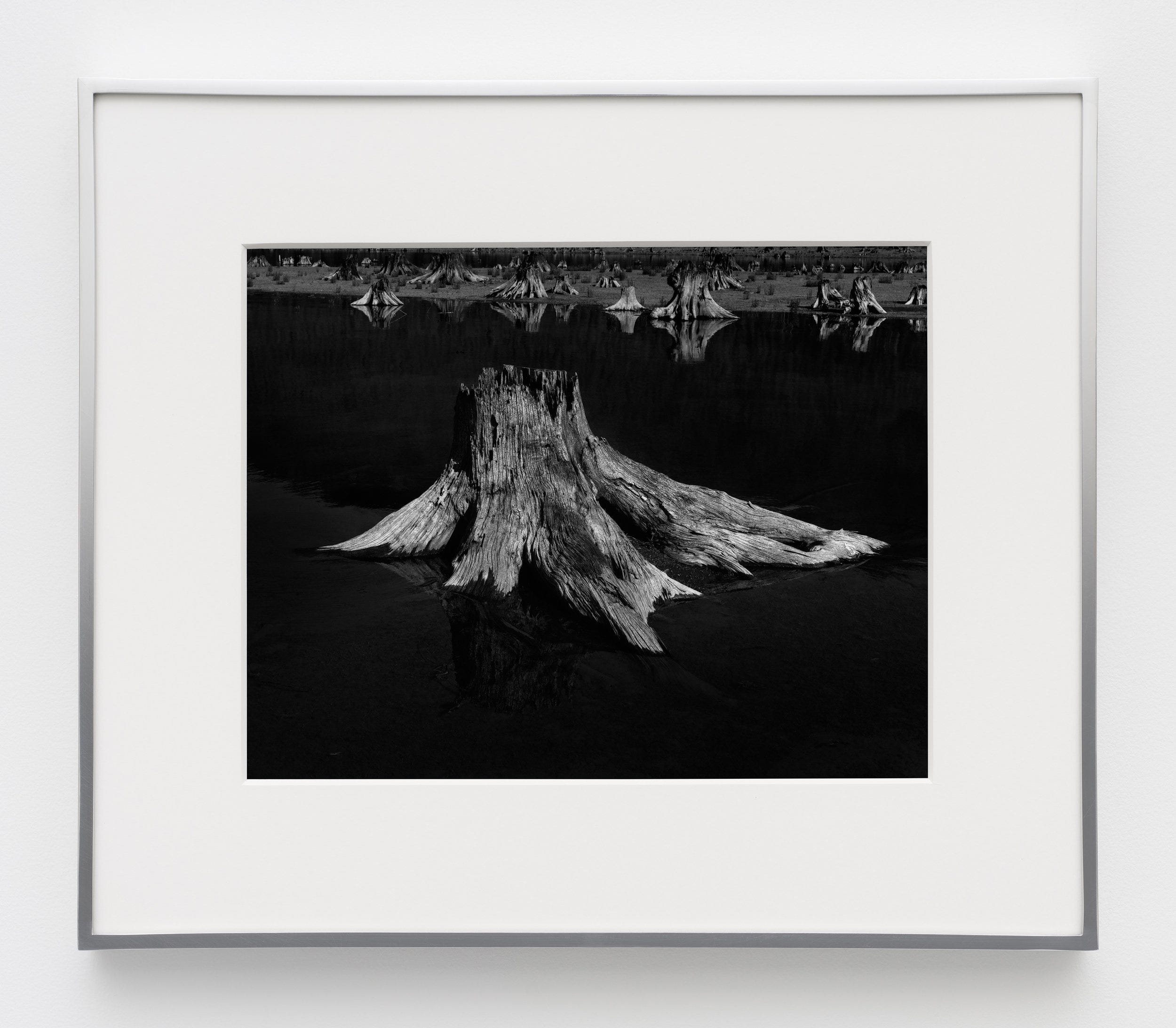
Silke Otto-Knapp explored this terrain most explicitly in her painting of figures. Generally presented as silhouette or with minimal shading, Otto-Knapp’s figures quite simply represent “people.” The complexity within such simplicity is that people are of course unique. Each newborn, as Hannah Arendt theorized it, adds a configuration of human possibility not yet seen in the world, thus humanity’s capacity is endless and changing. Any attempt to symbolically represent “people” as a kind of common mass elides everyone’s specificity and runs the danger of instituting stereotypes in place of individuals. In a pointed non-address to this problem, Otto-Knapp’s figures appear like shadows and they stick to the basic bodily movements of which the majority of human bodies are capable. It would be difficult to describe any individual figure in her work with greater specificity than “person facing away” or “person laying down,” and in place of details delineating individuals, specificity arises from group dynamics and relations, e.g. the dance as a whole versus the dancer’s place within it, the picture and the parts, thought and vision, all in tandem and as one.
What this allowed Otto-Knapp to accomplish is most on display in the painting titled Schattentheater (Chalk circles), 2017. Composed across five panels, the painting provides depictions of physical and mental spaces inhabited by its three central figures arrayed across a grey ground in the center panels. The right figure strides toward the painting’s right edge and into a field of abstract shapes that seem equally animated; wedges, angles, and a suprematist square, the dynamism of mental and physical movement powered by abstraction. The left figure, by contrast, has fallen to all fours before a vision of the material reality of three dimensional bodies, their visible requirements on display as figures that are stretched, distorted, and bent, splayed (dead?) across an abyssal black ground punctuated by two cubes and a sphere. (Note the visual rhyme between the abstract black rectangle protruding into the frame from the far top right and the pair of legs in white pants sticking straight up from the painting’s bottom left edge. Silke was never without her Germanic humor.) The third figure contemplates all this silently and alone, turned toward a black plane that is one side of a triangle seen in perspective. If the scenes at the painting’s side can be imagined as mental projections of the first two figures, then this final figure maintains an interiority kept invisible to anyone else. Like us, this figure stands before an image that is necessarily physical, dumb, and flat, but equally as abyssal, deep, and potentially (hopefully) transmittable as anything else occurring in the eyes and on the mind of someone in possession of both.
Here, Otto-Knapp chases something like the building blocks of human experience in the face of images and of art. The figures in her work navigate a reality that is always simultaneously illuminated and enshrouded by perception. Vision may be contextually determined for each historically specific subject and thus remain vague, but perception is phenomenological, a capacity that is prey to the scientific method, “knowable.” The ways in which our understanding of perceptible forms corresponds or breaks with our visions of the world constitute part of our ever shifting relationship to reality. This is perhaps one reason why the figures inhabiting Otto-Knapp’s late work are so often black silhouettes on gray grounds, not individual people, but shades of humanity, figures placed in spaces constructed precisely for “figuration,” on stage, somewhere in a picture plane, frozen mid-twirl, seen amidst others in a space purposefully lacking reality, but necessarily and completely made up of the stuff through and through.
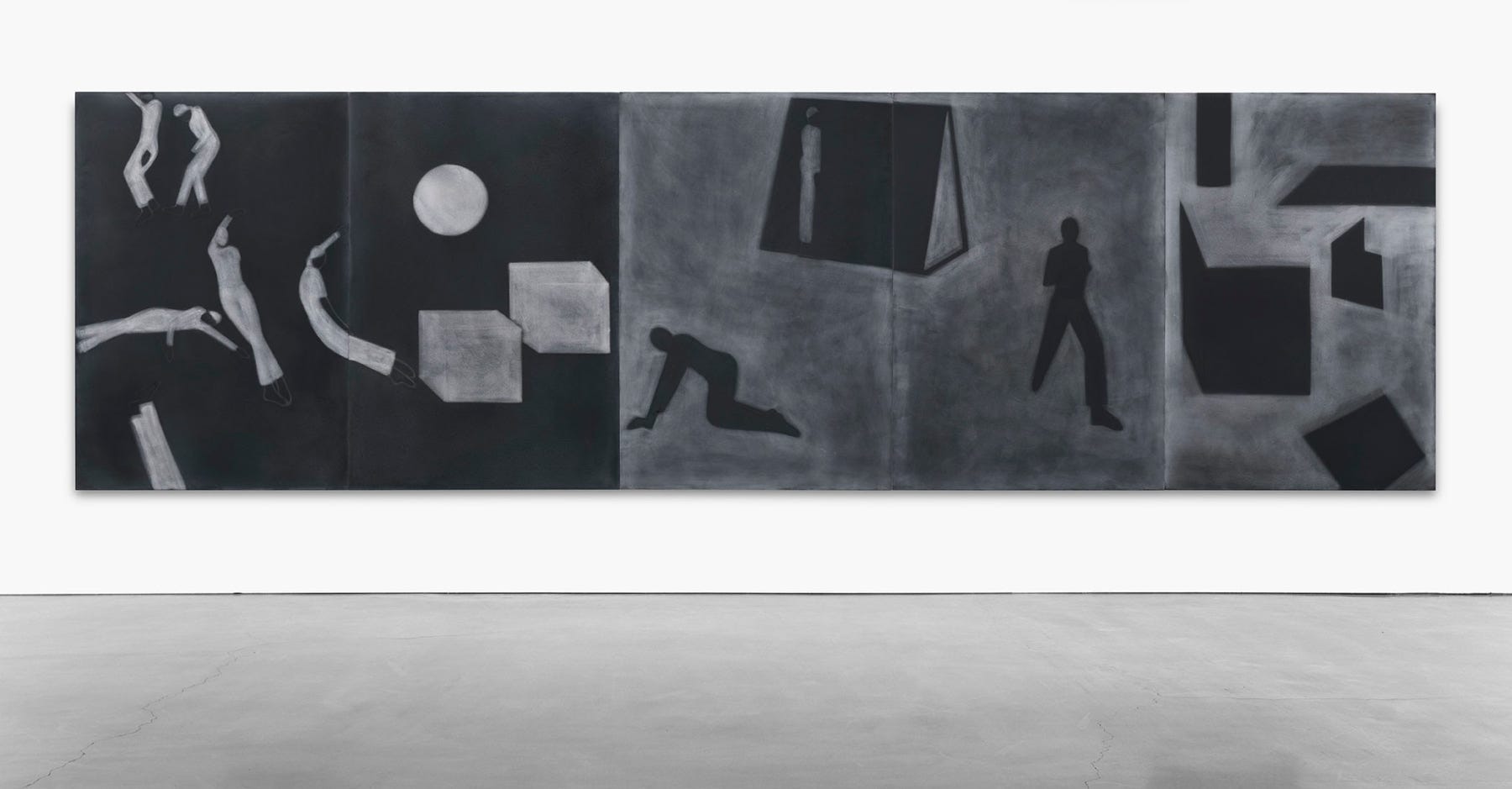
Obliquely, the anonymity of the very real individuals (friends of the artist) who appear in masks in the photos McKnight displayed in this exhibition, functions in much the same fashion. The flesh on display represents its erotic availability alongside the easiest symbol for its ultimate degradation and disappearance, the skulls beneath the skin. Languorous and sun-kissed, the bodies in Armijo McKnight’s photos here find themselves stilled by the camera and by the symbolic death that returns all individuality and any identities to the dust. It may be that “passion sits on the skull of humanity,” as Baudelaire had it, but here (and now) that passion must contend with the lifeless bones not only of humanity, but nature itself. And if the models in McKnight’s photos are made symbolic and anonymous by their death masks, then he does his utmost to provide the land and its other inhabitants the dignity of personhood that they desperately deserve. The stumps, fallen branches, and splintered limbs still somehow standing in these pictures are all reminders that in spite of our great powers, humanity makes no ultimate claim to primacy among life forms that does not at the same time condemn those forms to erasure.
And in many ways, voids are precisely what McKnight specializes in. The stark and inky blacks in his darkly crafted gelatin silver prints are of a kind only possible in analog photography, and he uses these qualities of his medium to great visual and metaphoric effect. A black lake of seemingly endless depth upon which the elegant corpse of a tree rests surrounded by countless others fallen into the distance, the hollowed sockets of each death’s head, or a shadowed crevasse into which a waterfall limply asserts itself as blurry highlight are all attempts to find formal equivalents for the serious and seriously queer moods, moments, and meanings McKnight is after. Death is also a void, a dark hole in space and time, but as anyone who has cruised can tell you, dark holes often call out to us and we approach them dick first. Erotic desire for queer people has long now competed with the spectre of AIDS alongside the historic and ongoing possibility of violence that comes from making oneself sexually available to strangers. McKnight places this desire and this violence inside of natural landscapes in order to show that nature as well endures such pain, such pleasure.
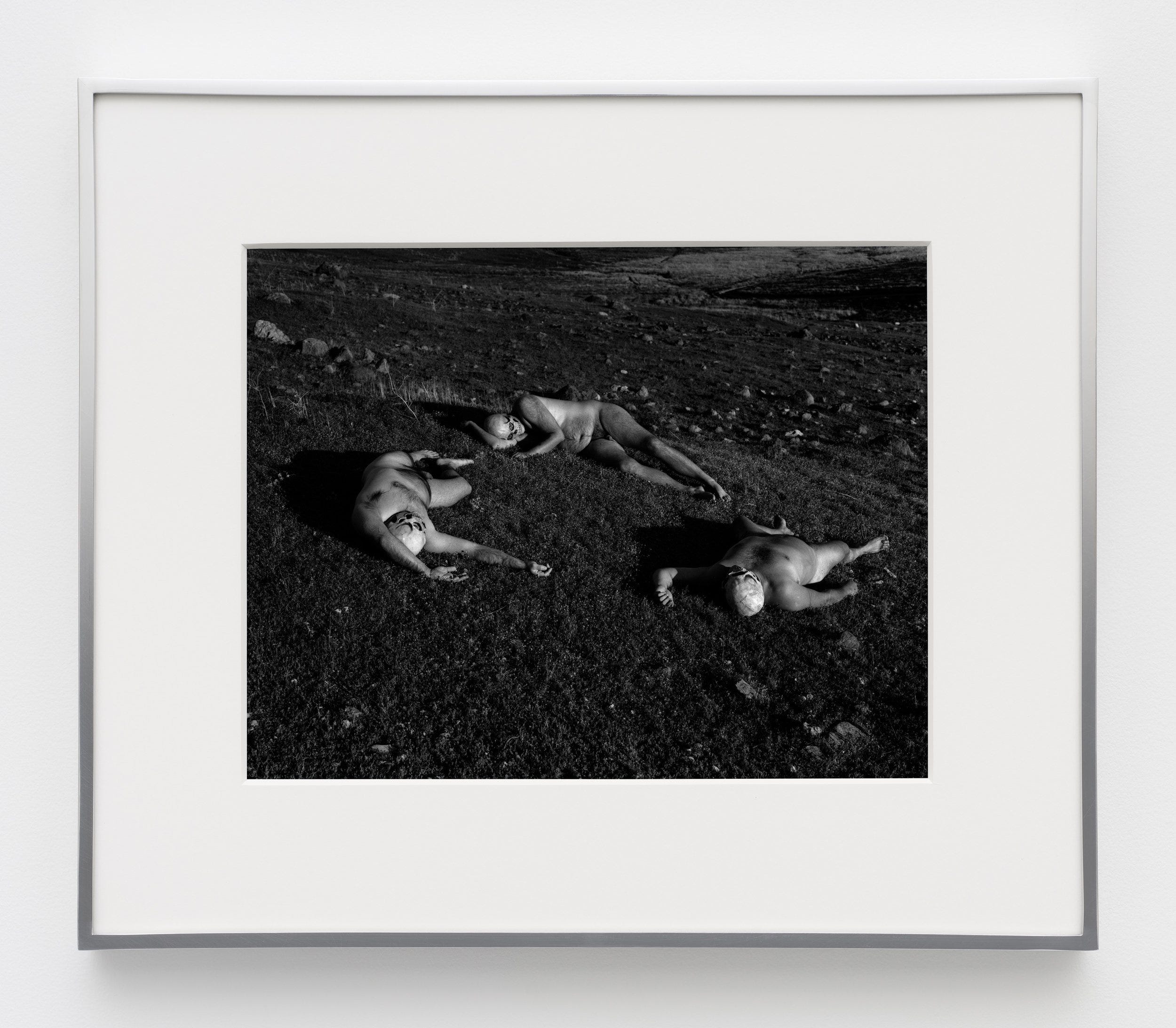
Which isn’t to say, of course, that nature has never contained death. As T.J. Clark asked of Poussin’s, Landscape with a Man killed by a Snake, c. 1648, “How much of death and terror can nature contain and still be posited as a value – as a world that human beings reach for, steadying themselves? Will any picture of the world that aims to contain the powers of blackness necessarily look forced – putting death at too great a distance, letting light win out predictably over dark, squaring and immobilizing its objects, faring and truing? Or can some pictures show the necessity – the naturalness – of that stilling and containment? Show it happening as part of the agony?”1 Humanity’s attempt to deal with death is nothing new, but also never old, and pictures are one means of gaining an intellectual grasp of what it is possible to see and to feel in a world wherein every moment really is un-repeatably unique, finitude is a certainty, and no language yet contains the knowledge of what occurs as a person’s distinctive singularity comes to an end and they return to the raw materials from which life assembles.
Yet, if anything is truly universal in a Modernist sense, if anything transcends identities, ideologies, languages, and species, anything at all, surely that thing is death. The animation of all life is tied to its inevitable arrest. Color bleaches, winds cease, smiles are pulled back to the bone. This is often translated as death giving life meaning, but that’s never seemed quite right. Life is what miraculously escapes simple cause and effect, it doesn’t “mean” it’s end, but is rather simply ended by it. What appears meanwhile are the movements and changes by which life can be recognized and in which meanings do arise to be shared as long as we can agree that the multiplicity of experience extends our empathy towards the unknowability of others and of ourselves. If we can somehow align our understanding with our feeling for what is beyond knowing, we might have something like a picture that shows how much death and terror nature can contain and still be posited as a value.
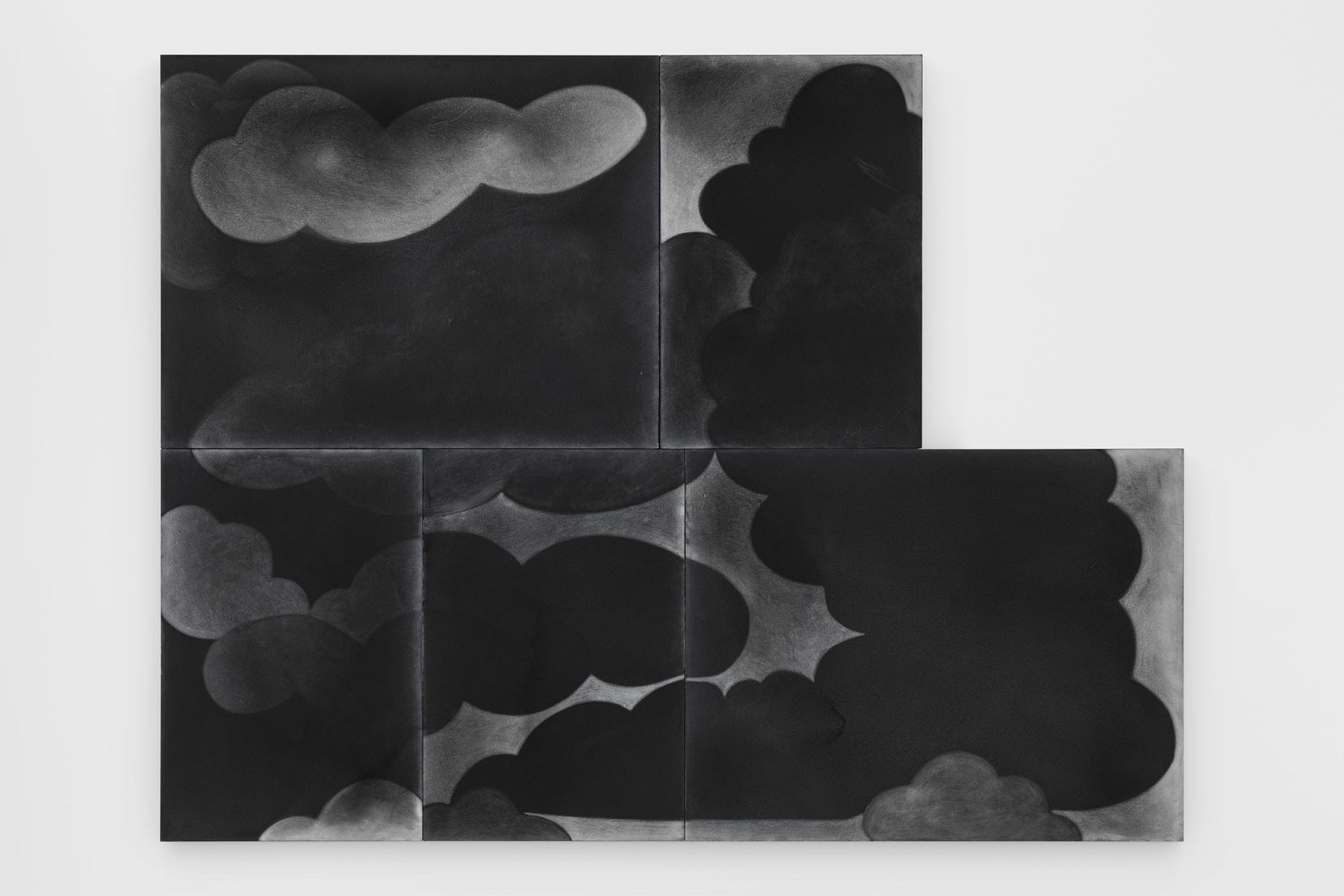
One attempted alignment struggles to be realized in Silke Otto-Knapp’s Clouds, 2021, which for this writer represents our best example of the heights Otto-Knapp was reaching towards and the breadth of her ambition. Approaching billboard scale, Clouds is a nearly symmetrical multi-panel work that appears to be missing its top right piece. Inspired by Georgia O’Keefe’s Sky Above Clouds IV, 1965, Otto-Knapp’s work similarly consists of a vision of clouds seen somewhere from within the sky. Whereas O’Keefe places us far above the clouds from the relatively recent heights of commercial air travel in 1965, Otto-Knapp places us squarely among their mist, clouds above and below, perhaps from the mid-flight vantage of falling from a great and terrifying height. Otto-Knapp further differentiates her work by composing the image not only across several panels, but nearly as several pictures as well. Each individual panel could quite easily do double service as a work of its own and indeed the entire composition nearly breaks apart upon scrutiny. Lines that continue across the gaps dividing two panels contend with a stark tonal contrast that fights any coherent shading for what would otherwise appear as a single cloud within the image. Black bumps up against white unexpectedly, contours do not perfectly match, and yet the image, expertly orchestrated even while clearly devoid of an entire segment, still coheres to the point that one can imagine the improbable world within which these comical clouds do silently witness another falling and fallen human point of view. It doesn’t take much convincing to see the top left cloud, this cartoon turd, as in fact a body in a bag face down and plummeting. Compared to the decay of stone or the slow melt of one element into another, the decay of death is preceded by just such a complicated and organized fall through grace we still have no better word for than “life.”
What becomes of the broken hearted? Jimmy Ruffin’s 1966 Motown classic gives us one answer. They decry this land of broken dreams, walk in shadows searching for light, and know no peace of mind, but they do so beautifully, with tender, full throated soul, they do it so you can dance. Silke knew she was dying and then she did. We know we are dying, but as of yet, we have not. At its hardest and most painful, at its worst, when love is lost and people are gone, when death is raining from the sky, it is still life that gives life meaning and it is with those seeking life that our solidarity must lie. It is against all destruction that lacks respect for the fact that the land and its inhabitants are one and the same that we must stand. Expansive and divided at once, we are the lives around us in all their form and color, and our actual humanity consists of nothing but the ways in which we recognize that fact. As Iris Murdoch told us, and as Otto-Knapp and Armijo McKnight have attempted to show us, “love is the extremely difficult realisation that something other than oneself is real.”2 We should try to remember that before it is too late.
Clark, T.J. The Sight of Death: An Experiment in Art Writing. Yale University Press, 2006. p. 174
Murdoch, Iris. Existentialists and Mystics: Writings on Philosophy and Literature. Allen Lane, 1998.